Published
How AI-Native Product Organizations Are Redesigning Execution
Most companies are adopting AI but almost none are redesigning how they work. That's why nothing is changing.
The typical playbook looks like this: Deploy Copilot. Add a chatbot. Wrap the internal wiki with AI. Then measure how many queries get answered automatically. Then wonder why, six months later, nothing has fundamentally changed.
The problem isn't the tools. It's what companies think they're solving.
The Wrong Framing: AI as a Productivity Layer
Most organizations treat AI as an acceleration layer on top of existing workflows. Write faster. Summarize quicker. Generate more output per hour.
That's a legitimate gain. But it's not a transformation.
When you add speed to a broken process, you get a faster broken process. The decisions are still poor. The feedback loops are still slow. The cognitive overhead is still there — just distributed differently.
Optimizing the execution of a flawed architecture doesn't change the architecture.
Four Structural Shifts in an AI-Native Product Organization
These shifts are not theoretical. They are already emerging in teams that are integrating AI beyond surface-level use cases. They redefine where time is spent, how decisions are made, and what actually creates leverage inside a product organization.
1. Decision architecture shifts from synchronous to asynchronous
Most product decisions happen in meetings. Meetings require alignment, scheduling, and presence. AI enables decisions to be prepared, contextualized, and pre-processed before humans are involved — so human judgment is applied where it creates leverage, not where it fills a coordination gap.
2. Feedback loops compress from weeks to hours
Traditional product cycles: ship, wait for data, review, iterate. With AI-native instrumentation, signal extraction and pattern detection can happen continuously. Teams stop waiting to learn.
3. Execution layers separate from cognitive layers
The highest-cost work in product is thinking clearly. In product management terms, this is what we call product discovery — the process of understanding problems deeply enough to make good decisions: talking to customers, testing assumptions, validating directions before committing resources.
Most product teams don't do enough of it. Not because they don't understand its value, but because execution — writing specs, creating documentation, managing backlogs, translating decisions into Jira — consumes the available time.
AI handles the execution layer. That frees humans to do the work that actually determines whether you build the right thing.
4. Memory becomes structural, not personal
In most organizations, institutional knowledge lives in people's heads. AI-native workflows create structured memory — context that is retrievable, usable, and compounding over time. Teams get smarter without depending on individuals to remember everything.
The Organizational Implication Most Leaders Miss
If you redesign at the architecture level, you change what team size means.
At Sygic, I ran Roadlords as Managing Director — a B2C trucking navigation platform. We grew it to 2 million installs across 22 countries, all with 2 senior product managers. No large team. No bloated org structure.
The leverage came from two things: clear objectives and fast decision paths. We knew what we were optimizing for, and we removed everything that slowed down the path from insight to decision to execution.
That model scales further with AI. The constraints that limited lean teams before — bandwidth, documentation overhead, research capacity — are now addressable at the system level.
What This Looks Like in Practice
Over the past months, I've been building this as a working system.
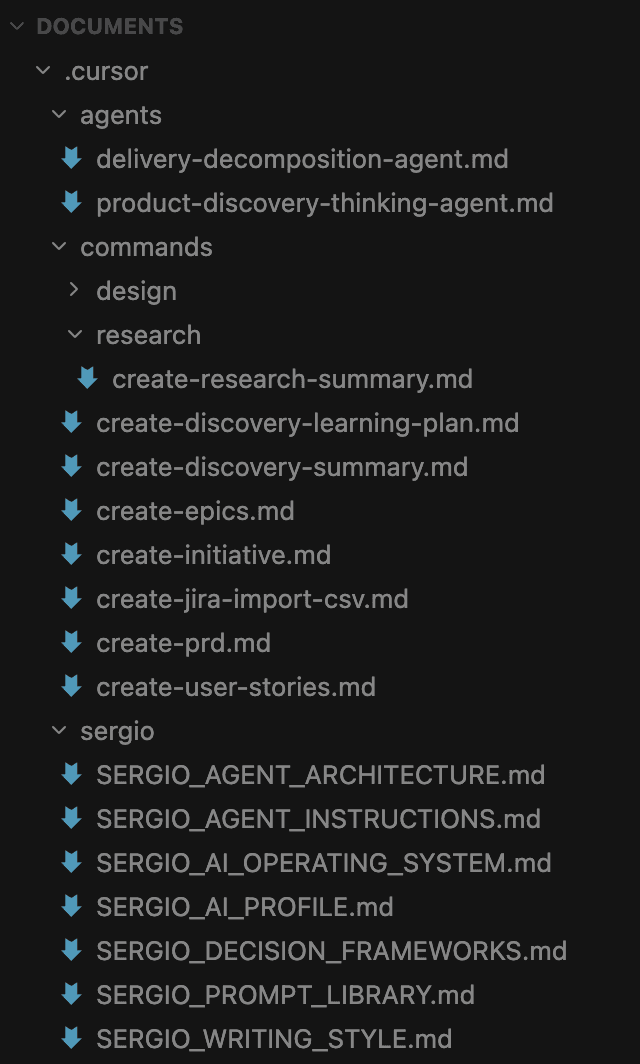
A product initiative starts with a brief: problem definition, user segment, success metrics. From there, agents automatically generate a discovery plan, PRD, epics and user stories in Jira.
What used to take 2–3 days now takes ~2 hours.
What that frees up isn't “productivity.” It's thinking time. Customer time. Discovery time. The agents handle the execution layer. The product managers handle judgment — the part that actually determines whether the product succeeds.
This isn't a product management tool. It's an operating model.
Where to Start
You don't need to rebuild everything at once. The entry point is clarity on leverage.
Ask three questions:
Where is human judgment being wasted on execution? Those are your first automation targets.
Where are feedback loops slowest? Those are your first instrumentation priorities.
What decisions repeat themselves? Those are candidates for decision architecture — documented frameworks that AI can apply consistently, freeing humans for novel judgment.
Map the architecture. Find the leverage points. Redesign from there.
The Window Is Open. Not Forever.
The companies that win won't be the ones using AI. They'll be the ones redesigned around it.
That advantage, once built, is hard to reverse-engineer.